

September 21, 2026
The skimmer is one of the hardest-working components on your pool, and it is also one of the most common sources of water loss. Homeowners in Marble Falls, Horseshoe Bay, and throughout the Texas Hill Country often notice their pool dropping water without any obvious crack or visible damage, and the skimmer is the first place a good technician looks. Pool Smart has diagnosed and repaired skimmer leaks on hundreds of Hill Country pools, and the pattern is consistent: the problem is usually subtle, easy to miss without the right equipment, and much cheaper to fix when caught early.
This guide walks through how to recognize a skimmer leak, what causes them in our climate, and what the repair process looks like.
Before getting into leaks, it helps to understand what the skimmer is doing. The skimmer is the rectangular box set into the pool wall at the waterline. Its job is to pull water from the surface, trap floating debris in the basket, and send water to the pump and filter system. Most pools have one or two skimmers depending on size.
The skimmer connects to the pool shell through a throat opening, and that connection point is where leaks most often develop. There are also fittings, a weir door, a basket housing, and in some pools, an equalizer line at the bottom of the skimmer that connects to the main drain. Any one of these components can become a leak source over time.
Water loss that stops at the skimmer opening. This is the most telling sign. Fill your pool to its normal level and watch where the water stops dropping. If it stabilizes right at the bottom of the skimmer throat rather than continuing to fall, the skimmer itself is the likely source. Water is escaping through the skimmer body or its connection to the pool wall and stopping once the water level drops below the leak point.
The bucket test points to a leak. The bucket test is a simple way to separate evaporation from an actual leak. Place a bucket of pool water on a step, mark both the pool level and the bucket level, and leave it for 24 hours. If the pool dropped more than the bucket, you have a leak somewhere. Skimmer leaks are among the most common causes of a failed bucket test in Hill Country pools.
Wet or soft ground near the skimmer. If the area around the skimmer or near the equipment pad stays damp without obvious explanation, water may be escaping through a cracked skimmer body or a failed connection underground. This is more common in pools where the deck has shifted slightly over time.
Air bubbles returning through the jets. When a skimmer is leaking, it can draw air into the suction line alongside water. That air travels through the pump and returns through the jets as bubbles. If you consistently see air in the return jets, it is worth checking the skimmer as a possible entry point.
Difficulty maintaining water level. If you find yourself adding water more than once a week during periods of mild weather without heavy splash-out or rainfall, something is leaking. Skimmers are among the first places to look.
The Hill Country's geology and climate create conditions that are hard on pool structures. Understanding why helps explain why skimmer leaks show up as often as they do around Marble Falls and Horseshoe Bay.
Limestone and soil movement. Much of Burnet and Llano County sits on or near limestone bedrock. Pools built in this terrain are subject to subtle settling and soil movement that puts stress on rigid components like the skimmer body and its connection to the pool shell. A shift of even a fraction of an inch is enough to crack a plastic skimmer or open up a gap at the throat seal.
Heat and UV exposure. Texas summers are hard on plastic. The skimmer body, weir door, and throat gasket are all exposed to intense heat and ultraviolet light year after year. Plastic skimmer components become brittle over time, and the gasket that seals the skimmer faceplate to the pool wall eventually hardens and fails to hold a watertight seal.
Freeze-thaw cycles. The Hill Country does freeze, and freeze events can crack skimmer bodies directly. Water expands when it freezes, and if water is sitting in the skimmer during a hard freeze, the resulting pressure can crack plastic components that were otherwise fine. This is exactly the kind of damage that shows up quietly and gets worse through the following pool season.
Age of the pool. Many Marble Falls and Horseshoe Bay pools were built during the area's growth period in the 1990s and early 2000s. Skimmers in pools that age are approaching or past the end of their expected service life. A skimmer that was installed 25 years ago and has never been replaced is a reasonable suspect anytime water loss becomes a complaint.
Guessing at a leak source is not a diagnostic strategy. Pool Smart uses a combination of methods to confirm whether the skimmer is the problem and exactly where the leak is occurring.
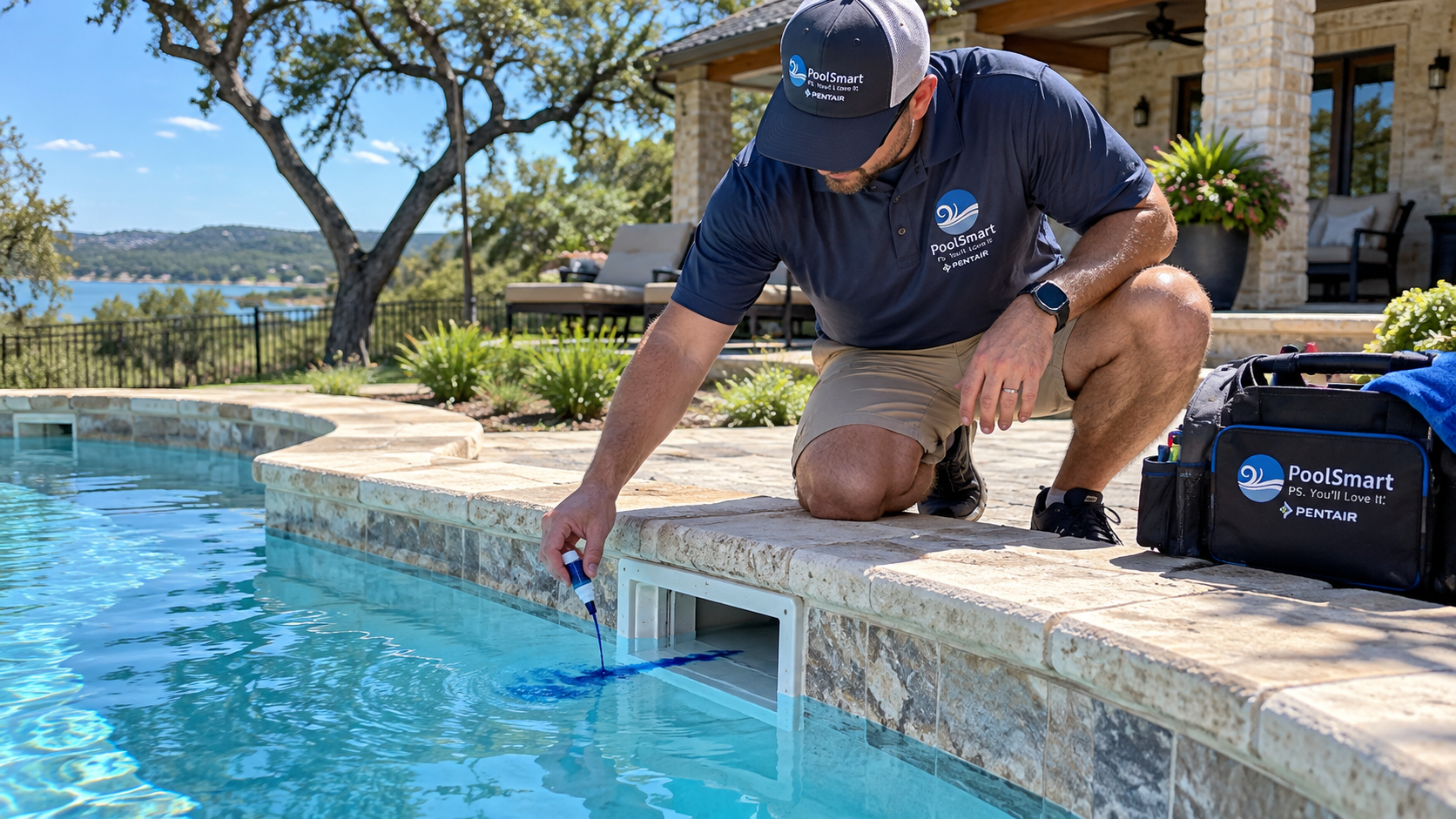
Dye testing. Dye testing is the most direct way to confirm a skimmer leak. With the pump off and the water still, a small amount of colored dye is introduced near the suspected area. If the skimmer throat, faceplate, or equalizer line is leaking, the dye will visibly pull toward and through the gap. This method is simple, non-invasive, and conclusive when done correctly.
Pressure testing. Pressure testing the skimmer line confirms whether the pipe running from the skimmer to the equipment pad is holding pressure. A line that fails to hold pressure has a break or separation somewhere underground. This tells us whether the leak is at the skimmer itself or further down the line.
Visual inspection. A close inspection of the skimmer body, faceplate, gasket, and throat often reveals cracking, erosion, or failed sealant that points directly to the leak source. In older pools, the plastic skimmer body can show visible stress fractures that confirm the diagnosis without additional testing.
The repair approach depends on where the leak is and how severe it is.
Gasket and faceplate replacement. If the leak is at the connection between the skimmer faceplate and the pool wall, the fix is typically to remove the faceplate, clean the surface, replace the gasket, and reinstall with fresh hardware and sealant. This is a straightforward repair that resolves a large percentage of skimmer leaks.
Skimmer body patching. Small cracks in the skimmer body can sometimes be addressed with a two-part underwater epoxy or hydraulic cement, depending on the location and size of the crack. This is a viable solution for minor damage when the skimmer body is otherwise in good condition.
Full skimmer replacement. When the skimmer body is extensively cracked, has lost structural integrity, or is simply at the end of its life, replacement is the right call. Pool Smart handles full skimmer removal and installation, including cutting the deck, removing the failed unit, installing a new skimmer, and restoring the deck surface around it. It is a bigger job than a gasket replacement but still far less expensive than months of unchecked water loss.
Equalizer line repair. If pressure testing reveals a failed equalizer line (the pipe connecting the bottom of the skimmer to the main drain), Pool Smart can use Pipepoxy trenchless pipe repair technology to fix the line without excavating your deck. This no-dig method injects a lining material through the pipe that cures in place and restores the line to full function. It is faster, cleaner, and significantly less disruptive than traditional pipe replacement.
A slow skimmer leak is easy to dismiss, especially if you are adding water occasionally and the pool still looks fine. But the compounding costs are real.
Water loss at even a quarter inch per day adds up to roughly 50 to 60 gallons of water lost from an average-sized pool every 24 hours. Over a Texas summer, that is thousands of gallons and a measurable increase in your water bill. In Marble Falls and Horseshoe Bay, where many properties are on well water, the impact shows up in pump cycles and well recovery times rather than a municipal bill.
Beyond the water cost, a skimmer leak that runs underground can erode the soil supporting your deck. As water saturates and then dries the ground repeatedly, the deck can begin to settle unevenly, creating trip hazards and eventually cracking the surrounding concrete or paver surface. The repair cost for a compromised deck is substantially higher than fixing the skimmer that caused it.
The bucket test is the most reliable way to tell. Place a bucket of pool water on a step, mark both water levels, and check back after 24 hours. If the pool dropped more than the bucket, you have a leak. If the water loss stabilizes at the bottom of the skimmer opening, the skimmer is the likely source.
In most cases, yes. Gasket replacements and minor crack repairs can often be done with the pool at normal water level or after dropping the water slightly below the skimmer throat. Full skimmer replacement may require lowering the water level, but a complete drain is rarely necessary.
A gasket replacement or minor crack repair can often be completed in a single visit. Full skimmer replacement typically takes a few hours of labor plus cure time for any sealant or concrete work. Trenchless pipe repair on the equalizer line can also be completed in a single visit in most cases.
The cost depends entirely on what the repair involves. A gasket replacement is a relatively minor expense. Full skimmer replacement is more involved and includes materials, labor, and any deck repair needed. Pool Smart provides upfront pricing after diagnosing the leak so you know exactly what the repair involves before committing to anything.
Temporary patch kits exist, but they are not a reliable long-term fix for most skimmer leaks. They can help you slow a minor leak in a pinch, but they do not address the underlying cause and typically fail within a season. A proper diagnosis and permanent repair is the better investment.
Pool Smart serves Marble Falls, Horseshoe Bay, and communities throughout the Texas Hill Country with professional leak detection and repair. If your pool is losing water and you suspect the skimmer, we can diagnose the source accurately and fix it right. Call (830) 220-5033 or contact us online to schedule a same-week appointment.

Standby generators keep your Hill Country home and pool protected when ERCOT goes down. Pool Smart Texas covers installation, freeze protection, and what to expect.

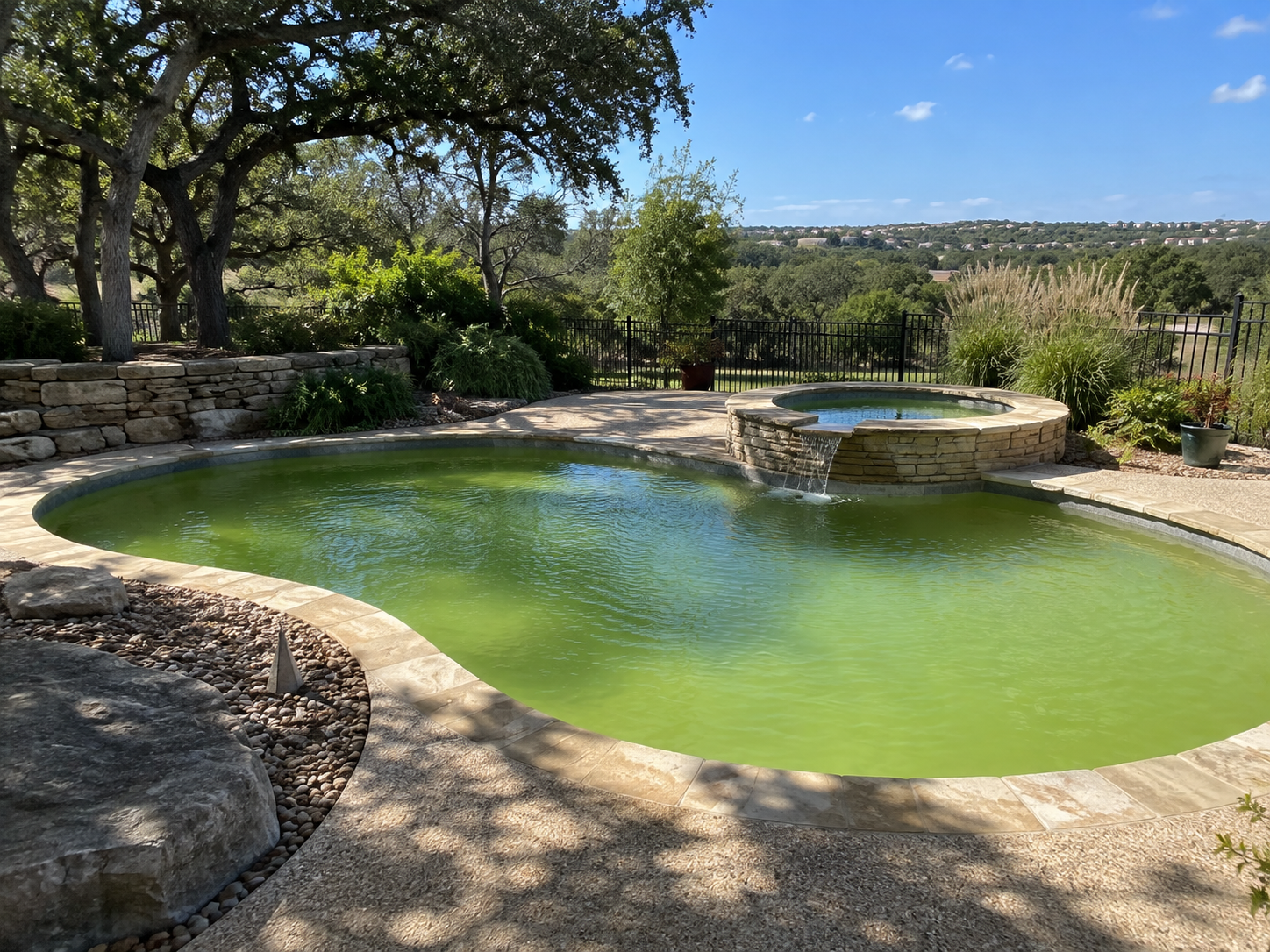
Green pool in Steiner Ranch? Here's Pool Smart Texas's step-by-step guide to safely shock, brush, and filter your way from green back to crystal clear.

Curious what pool automation actually costs and does? Here's what Kerrville and Lakeway homeowners should know before upgrading.
.svg.webp)
